
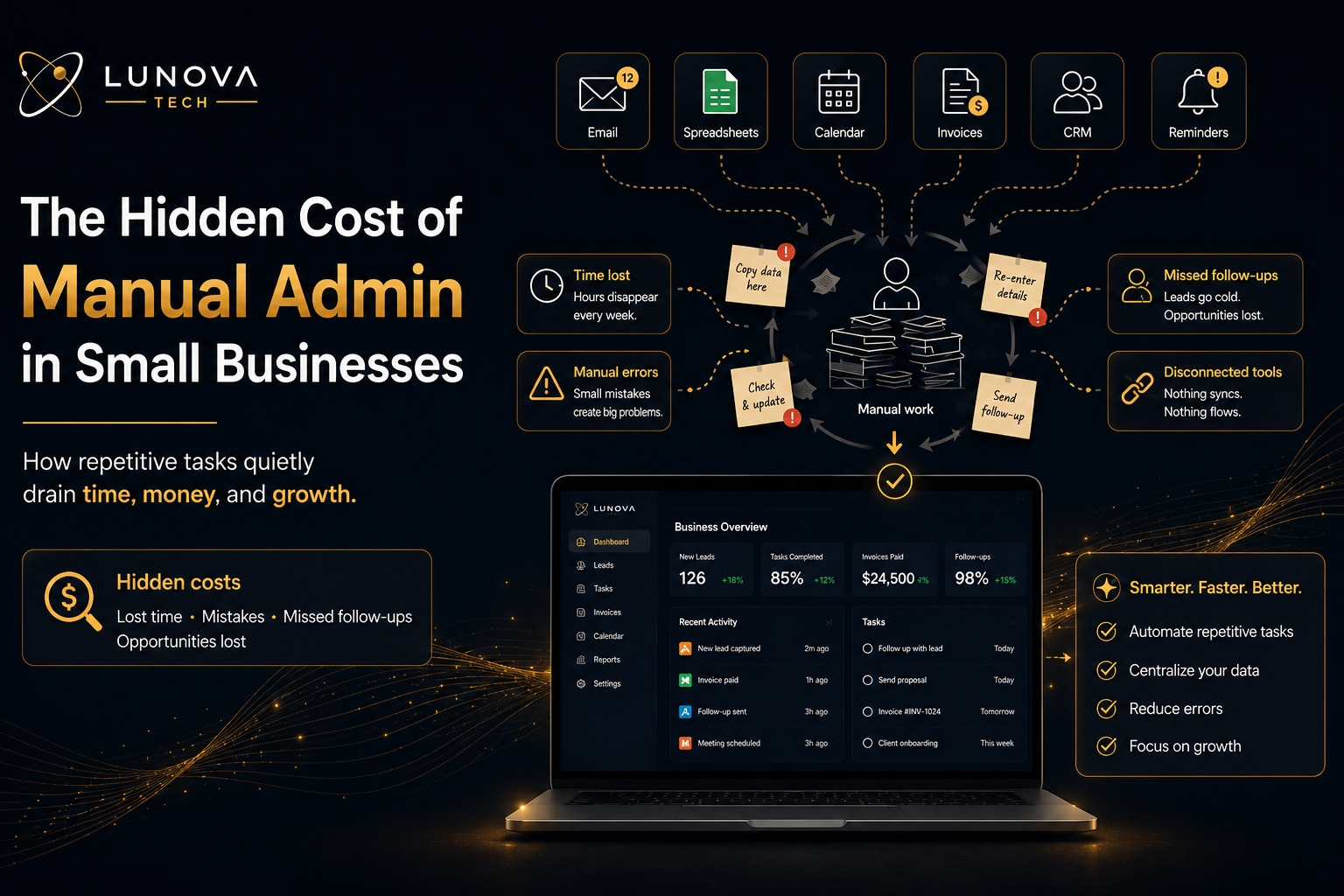
Manual admin is one of those problems that often goes unnoticed.
At first, it feels manageable. A customer enquiry comes in, someone replies. A booking needs confirming, someone sends an email. A quote needs following up, someone adds a reminder. A report needs preparing, someone pulls the information together manually.
None of these tasks seem like a major issue on their own.
But over time, they start to add up.
For many small businesses, manual admin quietly becomes one of the biggest drains on time, energy, and productivity. It slows teams down, creates avoidable mistakes, and often makes the business feel busier than it needs to be.
The real cost is not just the time spent doing the admin. It is the opportunities missed because your team is too busy managing repetitive tasks instead of focusing on higher-value work.
What do we mean by manual admin?
Manual admin is any repetitive task that relies on a person to move information, update records, chase actions, or complete the same process again and again.
This might include:
- copying customer details from a website form into another system
- sending the same follow-up emails manually
- chasing unpaid invoices
- updating customer records
- confirming appointments
- creating quotes from scratch
- checking multiple inboxes or platforms for updates
- manually preparing reports
- moving data between different tools
- reminding customers or team members about next steps
These tasks are often necessary, but they are not always the best use of someone’s time.
The problem is that manual admin usually grows with the business. As more enquiries, customers, projects, and internal tasks come in, the workload increases. Without the right systems in place, your team ends up spending more time keeping up than moving the business forward.
The cost of lost time
The most obvious cost of manual admin is time.
A task that takes five minutes may not seem like much. But if it happens 20 times a week, that is over an hour and a half gone. If several people across the business are doing similar tasks every day, the impact becomes much bigger.
Small businesses often underestimate how much time is spent on repetitive work because it is spread across different people, systems, and processes.
One person may be replying to enquiries. Another may be updating records. Someone else may be chasing information, checking emails, or building reports manually.
Individually, these tasks look small. Together, they can take hours away from sales, customer service, delivery, strategy, and growth.
Manual processes increase the risk of mistakes
When people are manually copying, updating, and moving information, mistakes are almost inevitable.
A customer name may be entered incorrectly. A follow-up might be forgotten. A quote could be sent with the wrong details. A task may be assigned to the wrong person. A lead might sit in an inbox without anyone noticing.
These errors can damage the customer experience and create extra work for the team.
In some cases, the mistake is easy to fix. In others, it can cost the business a sale, delay a project, or make the company look less professional.
Good systems reduce this risk by making key actions more consistent. Instead of relying on someone to remember every step, the process can guide the team or automate parts of the workflow entirely.
Missed follow-ups can mean missed revenue
One of the biggest hidden costs of manual admin is missed follow-up.
Many businesses work hard to generate enquiries through their website, referrals, social media, advertising, or networking. But if those enquiries are not handled properly, potential customers can quickly go cold.
A slow response, forgotten email, or missed callback can be enough for someone to choose a competitor.
This is especially important for service-based businesses, where timing and trust matter. If a potential customer sends an enquiry and does not hear back quickly, they may assume the business is too busy, unavailable, or disorganised.
A better system can help by making sure enquiries are captured properly, assigned to the right person, followed up automatically, and tracked through each stage of the sales process.
Disconnected tools create more work
Many small businesses use several different tools to manage day-to-day operations. This might include a website, email inbox, booking tool, payment platform, CRM, accounting software, project management system, and spreadsheets for reporting.
The problem is not always the tools themselves. The problem is when they do not work together.
If your website enquiry form does not connect to your CRM, someone has to move the information manually.
If your booking system does not send reminders, someone has to chase customers manually.
If your reports require data from three different platforms, someone has to pull everything together manually.
Disconnected systems often create duplicate work. Instead of making the business more efficient, they force the team to act as the bridge between each platform.
This is where automation and integration can make a big difference.
Manual admin makes it harder to scale
A process that works for 10 customers may not work for 100.
When a business is small, it is common for the owner or team to manage things manually. But as the business grows, these processes often become harder to maintain.
More enquiries mean more follow-ups. More customers mean more records to update. More projects mean more tasks to track. More team members mean more internal communication.
If the systems do not improve as the business grows, the team can quickly become overwhelmed.
This is why some businesses feel busy but not more profitable. They are doing more work, but much of that work is being absorbed by admin, chasing, fixing errors, and managing avoidable complexity.
Better systems help create structure. They make it easier to handle more work without every new customer adding more manual pressure.
Poor visibility leads to slower decisions
Manual admin does not just affect daily tasks. It also affects decision-making.
If information is spread across emails, documents, platforms, and individual team members, it becomes harder to understand what is really happening in the business.
You may not know:
- how many leads are waiting for a response
- which quotes need following up
- where projects are getting delayed
- which tasks are overdue
- which services are generating the most enquiries
- how much time is being spent on admin
- where customers are dropping off
Without clear visibility, business owners often have to rely on guesswork.
A better system can bring key information into one place, making it easier to track performance, spot problems, and make decisions based on real data.
Automation does not mean replacing people
Some businesses avoid automation because they worry it will make things feel impersonal.
But good automation is not about removing the human side of your business. It is about removing the repetitive work that gets in the way.
For example, automation can:
- send an instant confirmation when someone submits an enquiry
- create a new lead in your CRM
- assign tasks to the right team member
- remind customers about appointments
- send follow-up emails
- update records automatically
- trigger internal notifications
- generate reports
- move information between systems
Your team still handles the important conversations, decisions, and customer relationships. Automation simply makes sure the routine steps happen consistently in the background.
When should a small business improve its systems?
You may need better systems if your team is regularly saying things like:
“We forgot to follow that up.”
“I thought someone else was handling it.”
“I need to check three different places.”
“We are doing the same thing manually every time.”
“We are getting busier, but everything feels messy.”
“We need a better way to track this.”
These are signs that the current process is relying too heavily on memory, manual effort, or disconnected tools.
The solution does not always need to be complicated. Sometimes, a simple automation, CRM setup, workflow improvement, or custom dashboard can make a major difference.
The key is to identify where time is being lost and where better systems could remove unnecessary friction.
How to start reducing manual admin
The best place to start is by reviewing the tasks your team repeats every week.
Look for processes that are:
- repetitive
- time-consuming
- easy to forget
- prone to mistakes
- dependent on one person
- spread across multiple tools
- slowing down customers or team members
Once you understand where the problems are, you can decide whether the solution is automation, integration, a CRM, a custom application, or simply a better workflow.
Small improvements can have a big impact. Automating one enquiry process, improving one follow-up sequence, or connecting two systems can save time every week and create a smoother experience for both your team and your customers.
Final thoughts
Manual admin may not always seem like a major problem, but it can quietly hold a business back.
It takes time away from valuable work, increases the risk of mistakes, slows down follow-ups, and makes growth harder than it needs to be.
For small businesses, the goal is not to automate everything. The goal is to remove unnecessary friction and create systems that support the way the business actually works.
At Lunova Tech, we help businesses improve their digital systems through automation, CRM workflows, custom applications, and smarter website integrations.
If your business is spending too much time on repetitive admin, it may be time to build better systems that save time, reduce errors, and help your team focus on the work that matters most.