
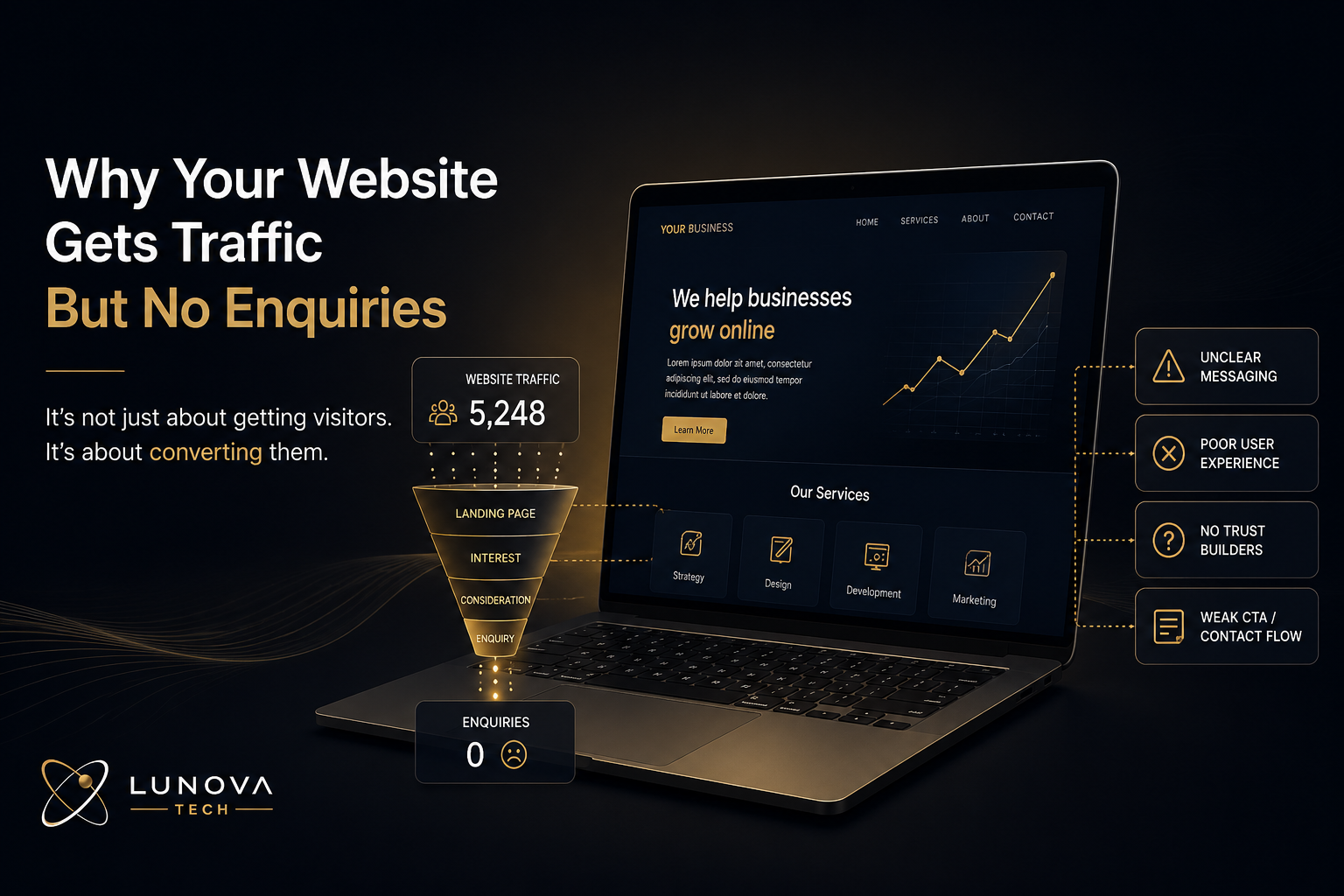
You have invested in SEO, Google Ads, or social media marketing. Your analytics show visitors arriving every day. Yet the phone is not ringing, your inbox remains quiet, and enquiry forms receive little attention.
It is frustrating because, on the surface, the marketing appears to be working. People are finding the website. The campaigns are sending traffic. The visibility is there. But if those visitors are not becoming enquiries, the real issue is often not traffic. It is conversion.
For many small and medium-sized businesses, improving the website conversion rate can deliver a stronger return than simply buying more clicks. More traffic may help, but only if the website gives people enough clarity, confidence, and direction to take action.
Traffic vs Enquiries: Understanding the Difference
Traffic measures visitors. Conversions measure actions. Those actions might be phone calls, quote requests, contact form submissions, consultation bookings, or downloads that move a prospect closer to a conversation.
A website can receive hundreds or thousands of visitors every month without generating meaningful business. That does not automatically mean the traffic is useless, but it does mean the website is not turning enough of that attention into opportunity.
For example:
- 1,000 visitors per month
- 1% conversion rate = 10 enquiries
- 3% conversion rate = 30 enquiries
That is the same traffic, but three times more leads. Before spending more money on marketing, it is worth asking whether the website is already converting effectively. If it is not, increasing traffic may simply increase the number of missed opportunities.
Visitors Don’t Immediately Understand What You Do
One of the most common website conversion problems is unclear messaging. A visitor lands on the page, scans the headline, looks at the first few lines, and still does not know exactly what the business does or why it matters to them.
This usually happens when websites rely on generic statements, internal language, or industry jargon. Phrases such as “innovative solutions for modern businesses” sound polished, but they rarely help someone decide whether they are in the right place.
Within five seconds, a visitor should be able to answer three questions:
- What does this company do?
- Who do they help?
- Why should I choose them?
A weak homepage headline might say: “Digital solutions that empower growth.”
A stronger version would be: “Websites and custom systems that help UK businesses generate enquiries and reduce manual work.”
Another weak service-page message might say: “We provide high-quality services tailored to your needs.”
A clearer version would be: “We design fast, conversion-focused websites for service businesses that need more qualified enquiries.”
The stronger examples are not complicated. They simply make the offer, audience, and value easier to understand.
Weak Calls-to-Action
Many websites expect visitors to work out the next step for themselves. The only “Contact Us” link appears in the navigation, there is no clear prompt after key sections, or every page contains several competing actions.
A call-to-action should guide the visitor towards the most useful next step. It should be specific, visible, and relevant to the page they are reading.
Examples of stronger calls-to-action include:
- Request a Quote
- Book a Discovery Call
- Schedule a Consultation
- Get a Free Website Review
CTA placement matters too. A strong website does not wait until the footer to invite action. It introduces a clear next step near the top of the page, repeats it after persuasive content, and places it close to proof points, service explanations, and pricing or project information where relevant.
The goal is not to pressure visitors. It is to make the path forward obvious when they are ready.
Your Website Doesn’t Build Enough Trust
Even when visitors understand what you do, they still need to believe you can deliver. Trust is especially important for service businesses because the visitor is often about to share contact details, discuss a project, or start a commercial relationship.
Useful trust signals include:
- Testimonials from real clients
- Reviews from trusted platforms
- Case studies with specific outcomes
- Client logos or recognisable sectors
- Certifications, partnerships, or accreditations
- Project examples that show the quality of your work
Why people don’t enquire even when they’re interested.
Interest is not the same as confidence. A visitor may like your service, but still hesitate because they are unsure what happens next, whether you work with businesses like theirs, how much the project might cost, or whether you are credible enough to contact.
Strong trust signals reduce that hesitation. They reassure the visitor that other people have made the same decision and had a good experience. Without that reassurance, interested prospects often leave to compare alternatives and may never return.
Poor User Experience Creates Friction
Conversion rate optimisation is not only about words and buttons. The experience of using the website has a direct impact on whether people enquire.
Slow loading pages
If a page loads slowly, visitors start forming a negative impression before they have even read the content. Slow pages create doubt, increase abandonment, and can make paid traffic more expensive by wasting clicks.
Mobile usability
Many business websites now receive a large share of their traffic from mobile devices. If buttons are awkward to tap, text is hard to read, images push important content down the page, or forms feel clumsy on a phone, enquiries will suffer.
Complicated navigation
Visitors should reach important information quickly. If services, pricing guidance, case studies, FAQs, or contact details are buried behind confusing menus, people are more likely to give up.
Long forms
Forms should ask for enough information to start a useful conversation, not everything the business might eventually want to know.
A poor enquiry form might ask for name, email, phone number, company name, job title, full address, project budget, exact timeline, how they heard about you, and a long mandatory message before the visitor has spoken to anyone.
A better first-step form might ask for name, email, phone number, company name, and a short project message. More detail can be gathered during the follow-up conversation.
You’re Attracting the Wrong Traffic
Sometimes the website is not the main issue. The traffic may simply be poorly matched to the offer.
This can happen when blog posts attract visitors with no buying intent, SEO targets broad keywords that do not reflect a commercial need, PPC campaigns send people to the wrong landing page, or social media posts generate curiosity without relevance.
A business might receive a high number of visitors from an informational article, but those visitors may be researching a general topic rather than looking for a supplier. Another business might run ads for broad terms and attract people who are too early in their decision-making process.
To separate traffic issues from website conversion issues, analyse:
- Which landing pages receive the most visits
- Which traffic sources generate enquiries
- Which keywords or campaigns show buying intent
- Whether visitors are arriving on pages that match their search intent
Recent CRO guidance consistently identifies traffic quality as one of the first things businesses should audit. If the wrong people are arriving, even a well-designed website will struggle to generate strong leads.
How to Diagnose What’s Actually Going Wrong
The best way to improve website lead generation is to diagnose the real bottleneck rather than guessing.
Check Google Analytics
- Which pages receive the most traffic?
- Which pages generate enquiries?
- Which sources produce engaged visitors?
- Where do people leave the site?
Review user behaviour
Heatmaps and session recordings can show where visitors click, how far they scroll, and where they appear to hesitate. They can reveal issues that analytics numbers alone do not explain.
Test your own website
Look at the site as if you were a potential customer and ask:
- Is the message clear?
- Is the CTA obvious?
- Would I trust this company?
- How easy is it to enquire?
These questions often reveal simple improvements that have been overlooked because the team is too close to the business.
Quick Wins That Can Increase Enquiries
Not every conversion improvement requires a full redesign. Some practical changes can be made quickly and tested over time.
- Rewrite your homepage headline so it clearly explains what you do, who you help, and the result you create.
- Add stronger calls-to-action throughout key pages, not just in the navigation or footer.
- Reduce form fields so the first enquiry feels easy to complete.
- Add testimonials, reviews, case studies, or project examples near important decision points.
- Improve the mobile experience by checking spacing, tap targets, forms, and page layout on real devices.
- Speed up page load times by compressing images, reducing unnecessary scripts, and reviewing hosting performance.
- Add clear next-step messaging so visitors know what happens after they enquire.
Each change removes a small barrier. Together, they can make the website feel clearer, more trustworthy, and easier to act on.
Conclusion
Many businesses assume they need more traffic when they actually need more conversions. The goal is not simply to attract visitors. The goal is to turn visitors into enquiries, conversations, and customers.
A website that converts effectively can generate significantly more business without increasing marketing spend. Improving conversion rates often delivers a higher return than investing in additional traffic generation, because it helps you get more value from the audience you already have.
If your website gets traffic but no leads, do not immediately assume your marketing has failed. Start by reviewing the clarity of your message, the strength of your calls-to-action, the trust signals on the page, the user experience, and the quality of the traffic itself.
Not sure why your website isn’t generating enquiries?
At Lunova Tech, we help businesses identify conversion bottlenecks and create websites that turn visitors into customers.
Get in touch for a website review and discover where opportunities may be slipping through the cracks.